by Jonathan Tomlinson
Share
Share
Over sixty university and CEGEP students from around the globe convened in Asprovalta, Northern Greece, between June 2 and July 14, 2025. Participants engaged in both onsite excavation at Argilos and detailed artifact analysis at the Amphipolis Museum under the guidance of seasoned experts.
We split our fieldwork between two vibrant sectors of the site: the Angelopoulos plateau and the Koutloudis commercial sector.
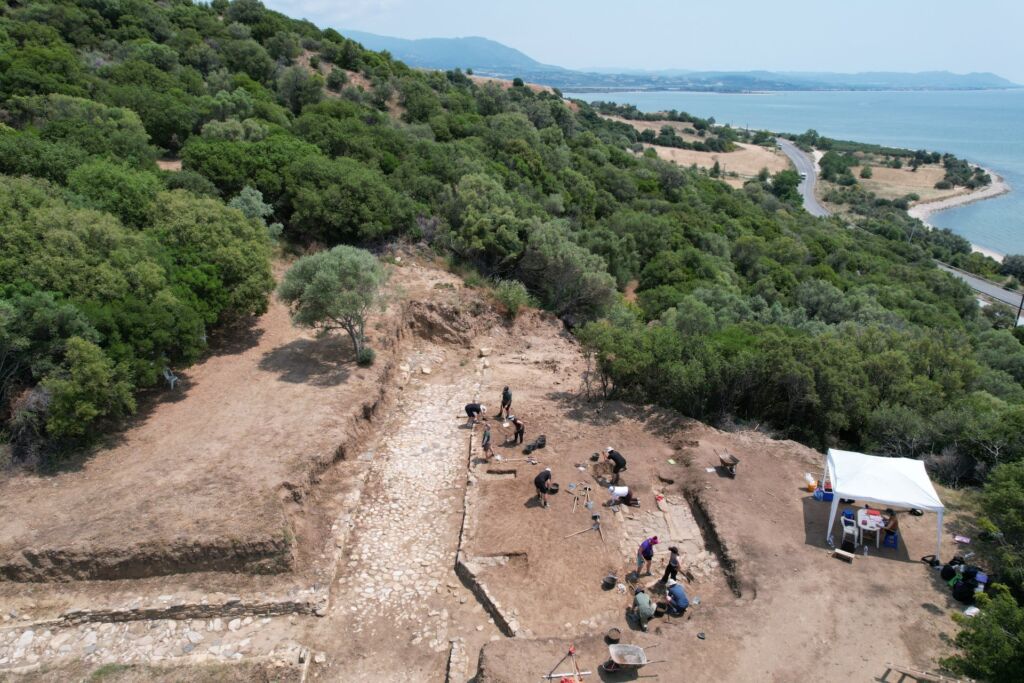
The Angelopoulos plateau
Discovered in 2022, the Angelopoulos plateau entered its third season of exploration. After mapping a north–south street intersecting a grand east–west avenue, our four-week goal was to unlock the purpose of a large structure just south of that avenue. Excavations confirmed the building served as a large house with an interior courtyard, offering new insights into domestic organization in ancient Argilos. A huge shout-out to Maria Clermont-Mignault and Ariane Poulin for taking charge of this sector with expertise and enthusiasm.
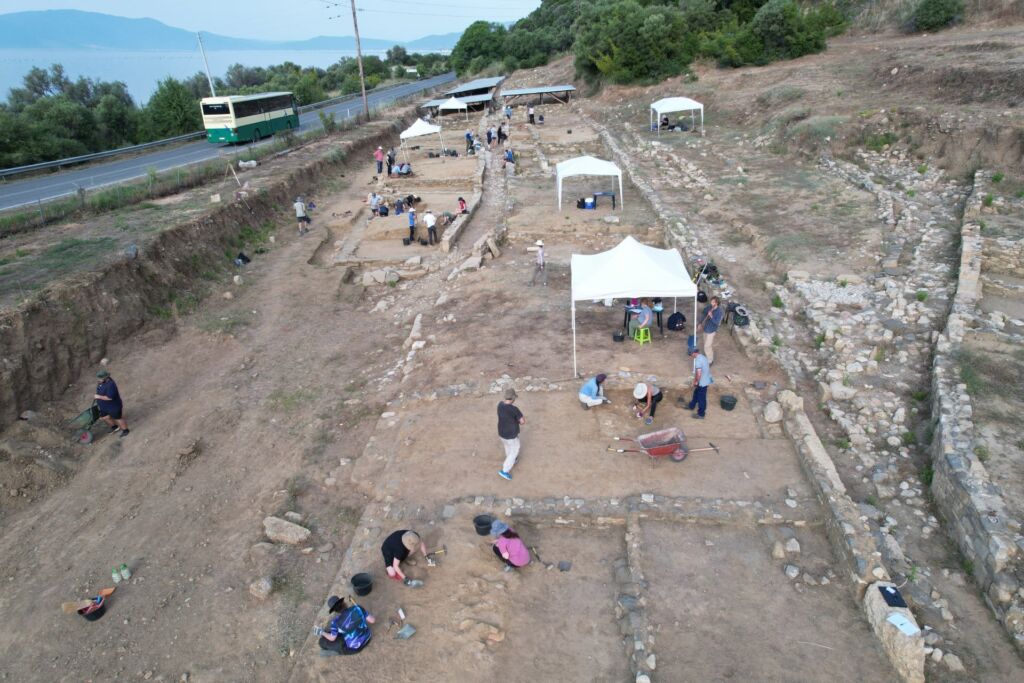
Koutloudis sector
In the commercial quarter, efforts concentrated on the eastern zone, with five trenches opened in Building P and four teams operating in Building Q. The primary aim was to expose the final occupation layer and assess whether it corresponded to Philip II of Macedon’s conquest in 357 BCE. Each room produced various interesting artifacts and architectural features, all of which aid in uncovering the pieces of the puzzle called Argilos.
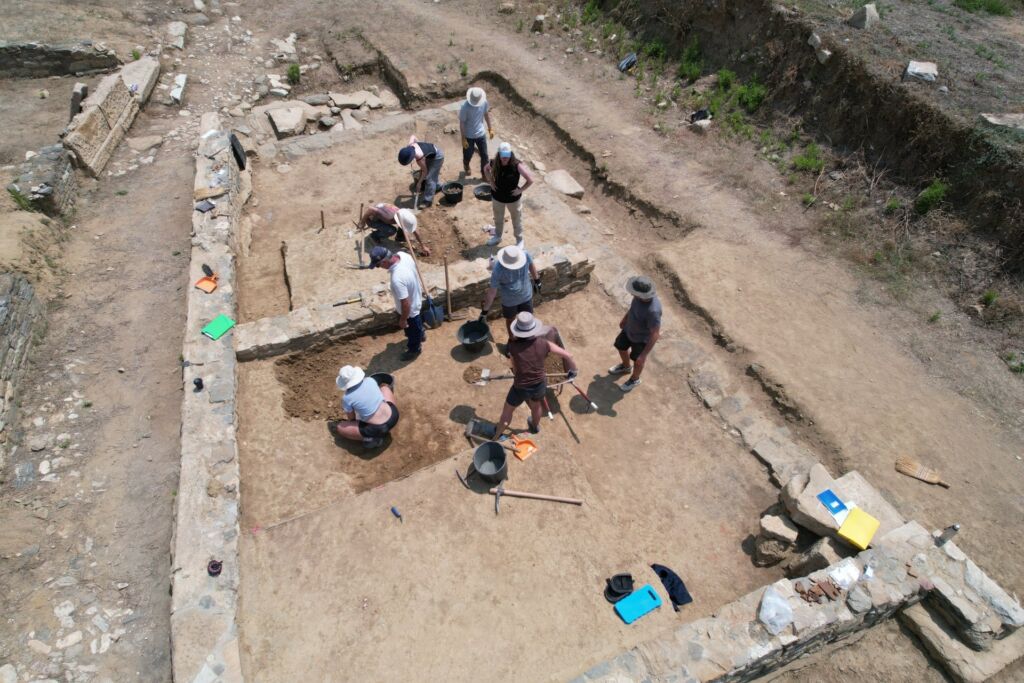
Koutloudis sector, Rooms P9 and P10 supervised by Lola Baillet

Keven Ouellet and Sophie Crawford Presenting their Palmette
We also undertook two special projects in this area. The first was the uncovering of the Eastern gate of the city, which we believe may be the main entrance of the city, judging by its proximity to the Agora and the large avenue that leads into the city. The second was the exploration of two massive drainage channels that directed water toward the Aegean. Thank you to Keven Ouellet, Shelby Vieira, Lola Baillet, Samuel Chaput, Ian House, François Gignac, and Niko Vasilikoudis for leading and mentoring these trenches.
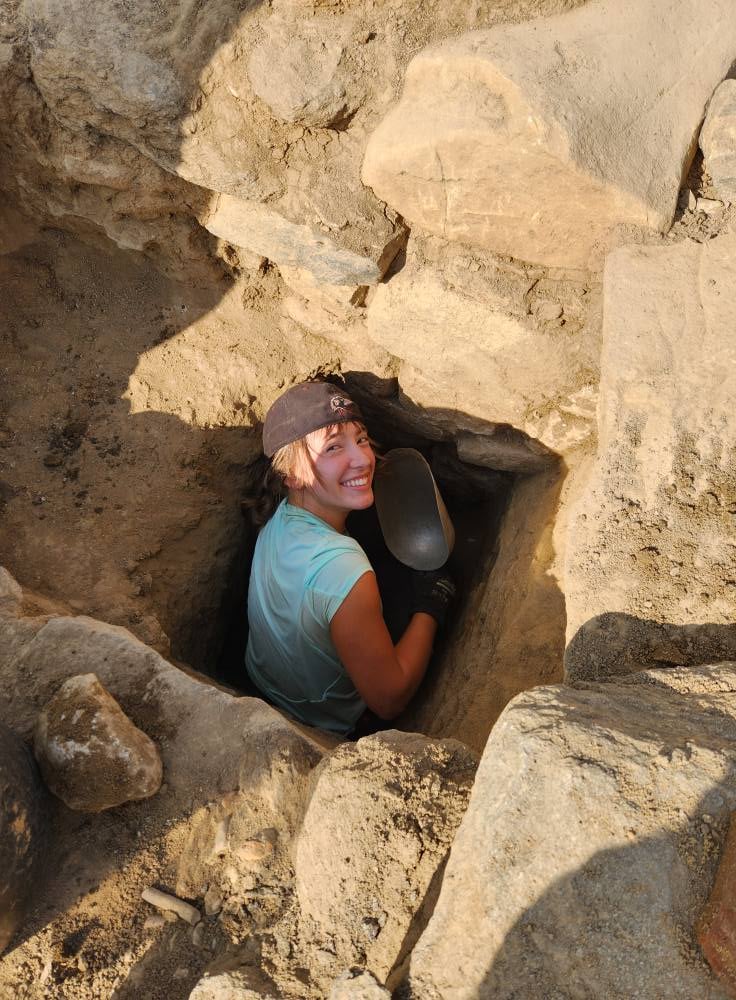
Sofia Aragones Working in the Drain near building P
This year we also revamped our real-time geolocation system, with the acquisition of a new advanced GNSS receiver to assist us in capturing precise coordinates and elevation data for every artifact and architectural feature. Integrating this data into our GIS platform helps us in understanding the site’s stratigraphy and spatial relationships. Special thanks to Frédéric Lemyre-Corbeil for his important contribution to this aspect of our work.

Frédéric Lemyre-Corbeil: Harnessing the Power of Satellites
The Amphipolis facility served as a critical center for post-excavation work. Students undertook the washing, identification, cataloguing, and preliminary interpretation of artifacts, thereby contributing directly to the narrative of Ancient Argilos. Saskia Deluy and Laure Sarah Ethier Boutet led this project, teaching students how to handle, identify and catalogue these artifacts, completing the excavation process for future studies. On top of this, as a special guest, Angelos Gkotsinas engrossed the students with a zooarchaeology course on pastoral economies and animal exploitation at Argilos.
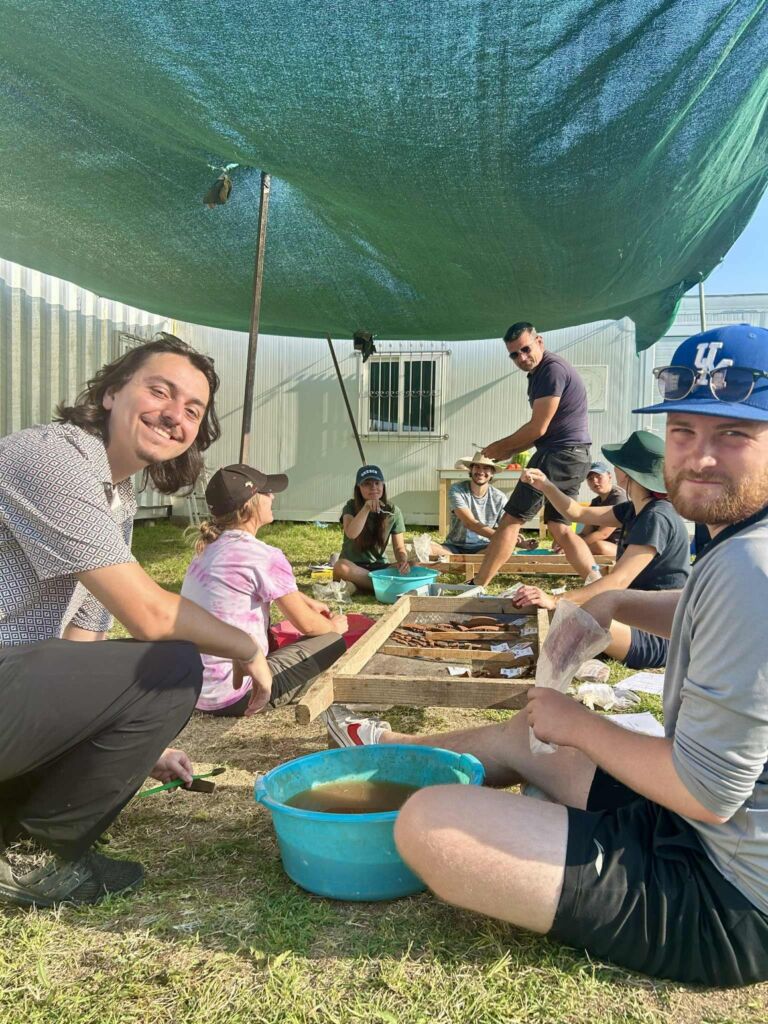
Students Engaged in Pottery Washing at the Museum
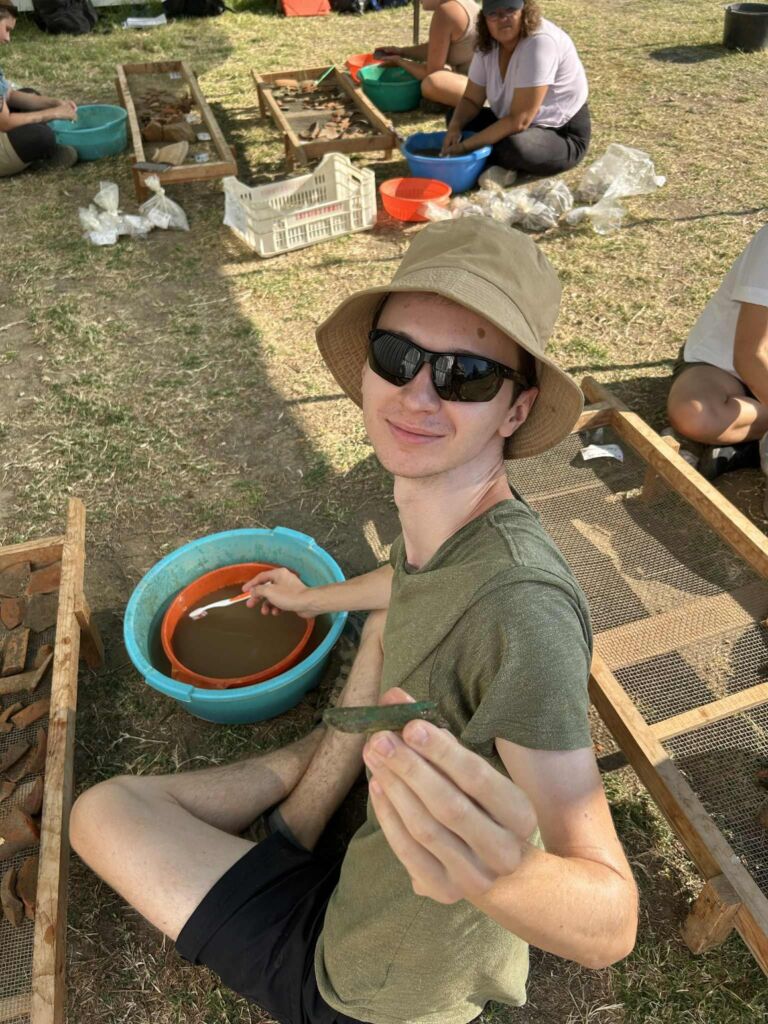
Pierre-Alexandre Audet showing off a Bone
At the back of the museum, two professionals were supporting us through their expertise. Christos Kountouras, our draftsman, produced precise and detailed visual documentation of each object in the form of technical drawings. On the other side was conservator Dimitra Kampouri, who collected all specialized artifacts and ensured that they were stabilized, reassembled, and preserved for centuries to come. Heartfelt thanks to director Dimitra Malamidou, head guard Giorgos Galios, and the entire museum staff for their warmth and support.
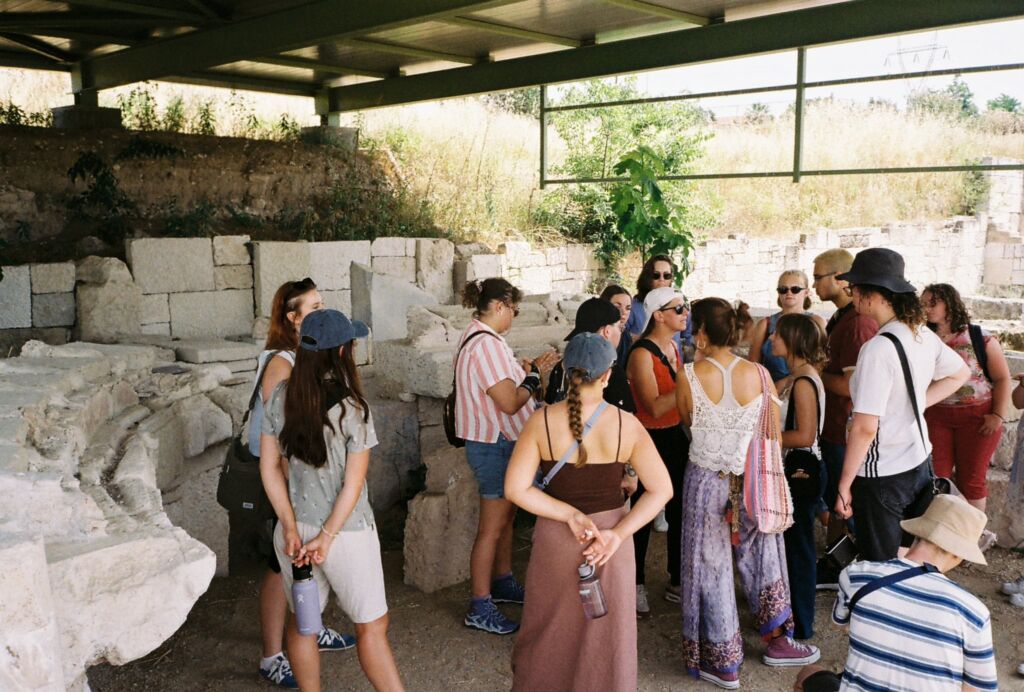
Shelby Vieira Presenting at Pella
To balance hard work with inspiration, we organized weekly field trips to various sites and museums at Pella, Vergina, Thessaloniki, Stagira, Thasos, and Philippi. Each visit deepened our students’ appreciation for the region’s layered history and helped them identify their findings and look forward to what they may find in the future.

Keven Ouellet presenting the Hellenistic Mansion at Argilos
The 33rd season of excavation at Argilos yielded significant discoveries, refined our methodological approaches, and generated new research questions. Thank you once again to all students, faculty, and staff for their dedication, as their collective efforts lay the groundwork for forthcoming campaigns, ensuring that Argilos will continue to yield insights into the ancient world.
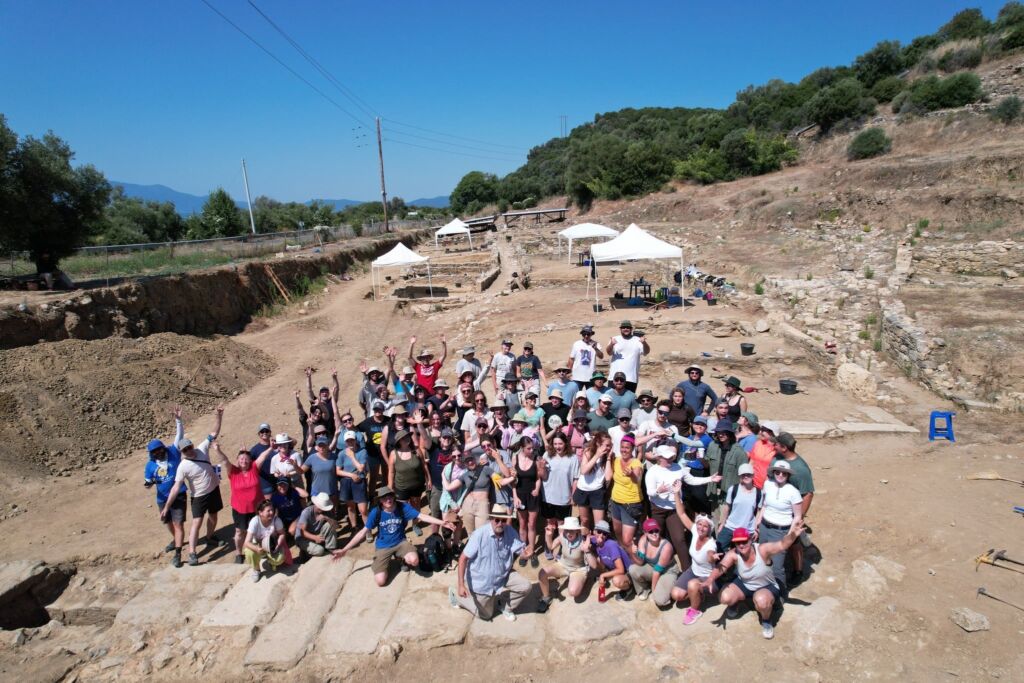
The Argilos 2025 Team

The new academic year has begun at the Institute, and we welcome the Institute’s 2025-2026 Neda and Franz Leipen Fellow, Eric Del Fabbro, and Concordia University intern, Aiko Byrne. Eric Del Fabbro is a PhD candidate in the

In 2025, the Eastern Boeotia Archaeological Project worked for five weeks (May 18 to June 21), focused on studying the excavated remains from ancient Eleon and survey material from the surrounding region. We have been working in the